Dreams About Flying — What They Might Mean
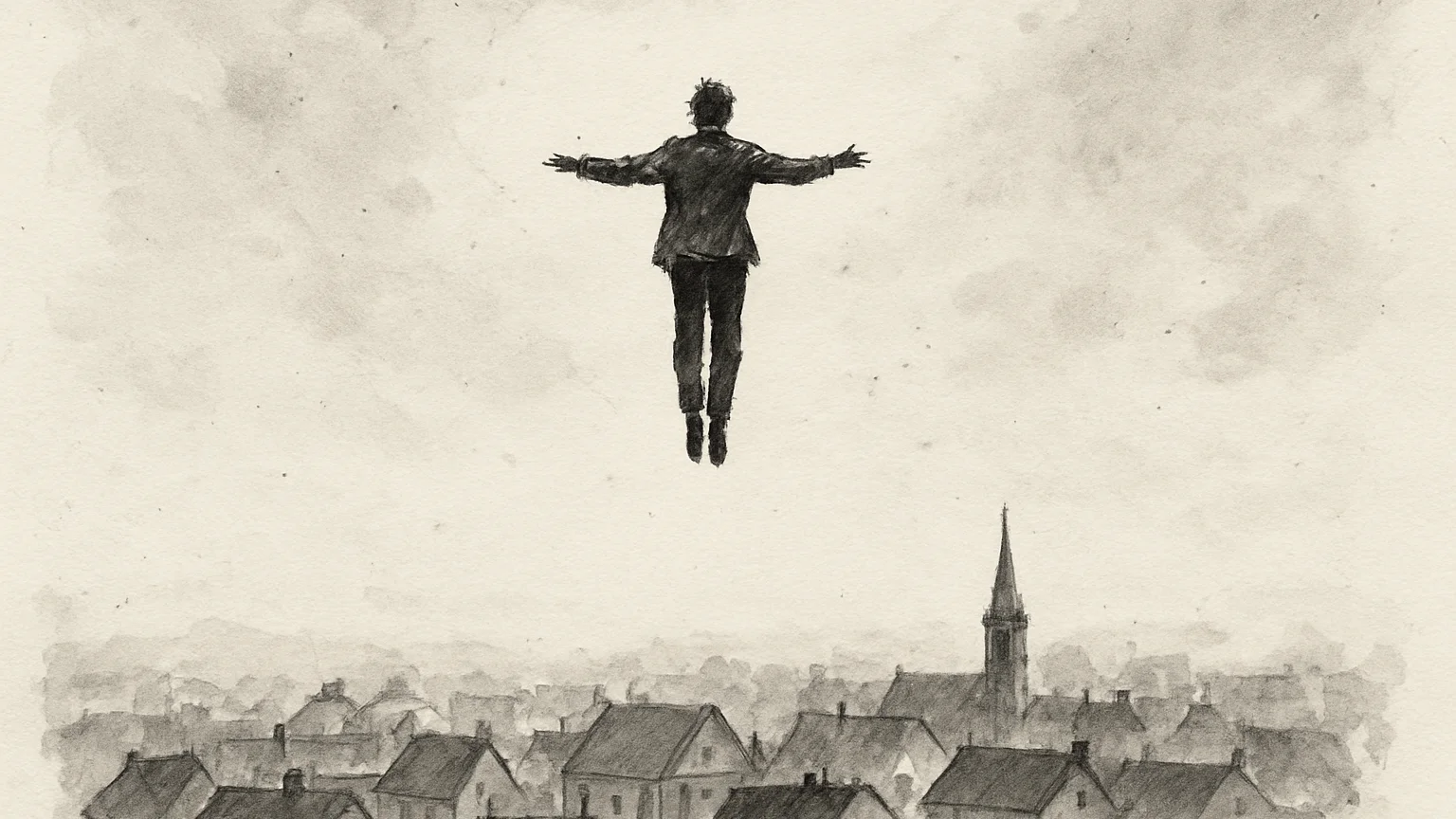
Dreams about flying are the exception in this library: the dream people search not to be rid of, but to get back. They tend to arrive when something constraining has lifted — or when part of you is testing whether it could — and the way you flew matters as much as the fact that you did.
What this dream might be about
Every other dream on these pages, people want explained so it will stop. This one they want explained so it will come back. Ask a room of adults about their flying dreams and watch the faces change — people remember flights from thirty years ago in detail they can’t summon for last week, and some will tell you, a little embarrassed, that they’ve tried to dream it again on purpose. Whatever this dream is doing, it’s the only one that leaves people homesick for it.
What it’s usually doing, as far as anyone can tell, is rehearsing freedom. Flying dreams keep company with lifted weight — the semester ending, the notice handed in, the recovery taking hold, the decision finally made after months of carrying it unmade. Sometimes the dream trails the liberation by a few nights, a delayed celebration. Sometimes it comes first, before any outward change, and then it’s less a report than a rumor: some part of you has begun to suspect the constraint isn’t load-bearing anymore, and is testing the air while the rest of you sleeps.
But the fact of flight is only half the dream. The other half is the mechanics — and dreamers know, the way you know the health of a friendship from a single hello, exactly how their flying went. Effortless soaring is one dream. Straining to stay aloft is another. Rising higher than you meant to, with the ground pulling away and control thinning, is a third — the version where freedom starts shading into its own kind of fear. The dream’s real subject often lives less in the altitude than in the effort: how much of you it took to stay up there, and what it felt like when you started coming down.
There’s also the matter of the view. Flying is the only dream that routinely hands you perspective as a physical fact — your street becoming a diagram, your commute a thin gray thread, the whole map of your life suddenly legible and small. Some flying dreams seem to be for this: not escape but altitude, the mind pulling back far enough to see a situation whole. If you woke remembering less the wind than the view, it may be worth asking what you finally saw the shape of.
None of these readings is the meaning. They’re the places this dream tends to visit. Which one it visited in you is something only your night, and the life around it, can say.
Soaring effortlessly
No flapping, no strain — the air simply agrees with you, and you go where you look. This is the version people spend decades trying to return to, and it tends to visit at genuine high-water marks: mastery arriving after long effort, love that’s going well, the season when the pieces of a life briefly stop fighting each other. It asks the least interpretation of any dream on these pages. Sometimes the news is simply good, and the dream is how you heard it.
Struggling to stay airborne
You can fly — technically. Two feet up, maybe ten, flapping like the air is thickening, sinking whenever your attention slips, dodging power lines that were never this numerous in life. This may be the most common flying dream of all, and its subject is usually the gap between capacity and ease: something you’re free to do, entitled to do, even good at, is costing far more effort than it should. The power lines are worth a second look. The dream strung them at exactly the height it thinks your ceiling is — and it’s usually lower than the sky and oddly specific.
Flying to escape
Wings as exit: the pursuer closes in, and instead of running you rise, out of reach, watching the danger shrink below. This version sits halfway between this page and another one — it’s a chase dream that found a door — and how it feels depends on what the leaving costs. Sometimes it’s pure relief, the dream granting you the way out that waking life hasn’t. But if you’ve flown away from the same thing more than once, the dream may be keeping an honest ledger: escape that has to be repeated isn’t escape yet. It’s altitude.
You used to be able to do this
Mid-dream, you remember: you know how to fly. You’ve done it a hundred nights. And now — nothing, or a half-rise and a settling, like the air revoked something. This version has a particular ache to it, and it tends to track lost lightness in waking life: a confidence, an ease, a younger self’s certainty that has gone quiet under obligation. The dream isn’t taunting you. Remembering you could fly is the first half of the old dream trying to restart — and it may be asking what grounded you, and whether that thing still gets a vote.
Flying too high
The ground lets go of you rather than the other way around. You’re higher than you meant to be, the air is thin, the climb won’t stop answering to you — and the dream that began as freedom is now about control. It tends to find people mid-ascent in waking life: the promotion that’s bigger than it looked, the success gathering its own momentum, the visibility that arrived before the readiness. Wanting to come down a little is not a failure of nerve. Even in the dream, the trouble was never the flying — it was the feeling that the altitude had stopped being a choice.
Flying with someone — or losing them below
Rarer, and tender: someone beside you in the air, or a hand you’re holding that keeps the other person aloft. And the shadow version — rising while someone you love stays on the ground, getting smaller. These dreams tend to be about trajectories: growing alongside someone, or growing past them, or the quiet fear that your freedom and your bond are pulling in different directions. The dream borrowed the sky to draw the diagram. The distances in it are the part to sit with.
What matters more than the symbol
Here is the honest limit of a page like this one: the same flight means differently in different lives. Soaring the week you leave a marriage is not soaring the night before a career leap, and neither is the low, snagged, effortful flight of someone six months into caring for a sick parent. A dictionary can tell you what a word tends to mean. It cannot tell you what the sentence meant — and the dream you had was a sentence, spoken once, in your voice, in the middle of your particular life.
No one can tell you what your dream means — including us. What the flight was doing in your night depends on what surrounded it: what had just lifted, or was asking to; how the air treated you; whether you rose on purpose; and what you felt at altitude — joy, vertigo, or the strange calm of finally seeing the whole map. Those details are where the meaning lives, and they belong to you.
Before you go looking for meaning
One practical note. If you miss this dream, it’s one of the few you can actually court. Flying dreams surface most in long, unhurried morning sleep, when the night’s later chapters run rich and slow — alarms and short nights mostly cost you this dream, not the anxious ones, which is its own small injustice. Keeping a record of your dreams reliably brings more of them back within weeks, and flying is the classic doorway to lucidity: dreamers who write down their nights start noticing, mid-air, that this shouldn’t be possible — and from there, the sky is negotiable. This is the one page in this library with instructions. Sleep longer, wake slower, write it down.
Frequently asked questions
What does dreaming about flying usually mean?
The pattern most often reported links flying to freedom and capability — these dreams tend to arrive when a constraint has lifted, or when part of you is testing whether it could. But the mechanics matter as much as the fact of flight: soaring effortlessly and straining to stay two feet off the ground are close to opposite dreams wearing the same costume.
Why can't I stay in the air in my flying dreams?
The struggling version — sinking, flapping, snagging on power lines — is one of the most common forms this dream takes, and it usually says less about flight than about effort: something in waking life that should feel liberating is taking everything you have, or confidence keeps cutting out mid-rise. The ceiling in the dream is worth examining. It often has a name.
Are flying dreams the same as lucid dreams?
Not the same, but they're neighbors. Flying is the classic trigger for lucidity — mid-flight, a dreamer notices this shouldn't be possible, and the noticing wakes them inside the dream. It's also the first thing most people choose to do once lucid, which says something about what the dream is for.
Why did my flying dreams stop?
Many people fly often as children and rarely as adults, and no one fully knows why — though dream recall in general fades when sleep gets shorter and mornings get rushed. The dream usually isn't gone, just unremembered. Slower wakings and writing down what's there tend to bring back more of the night, this dream included.