Dreams About Being Lost — What They Might Mean
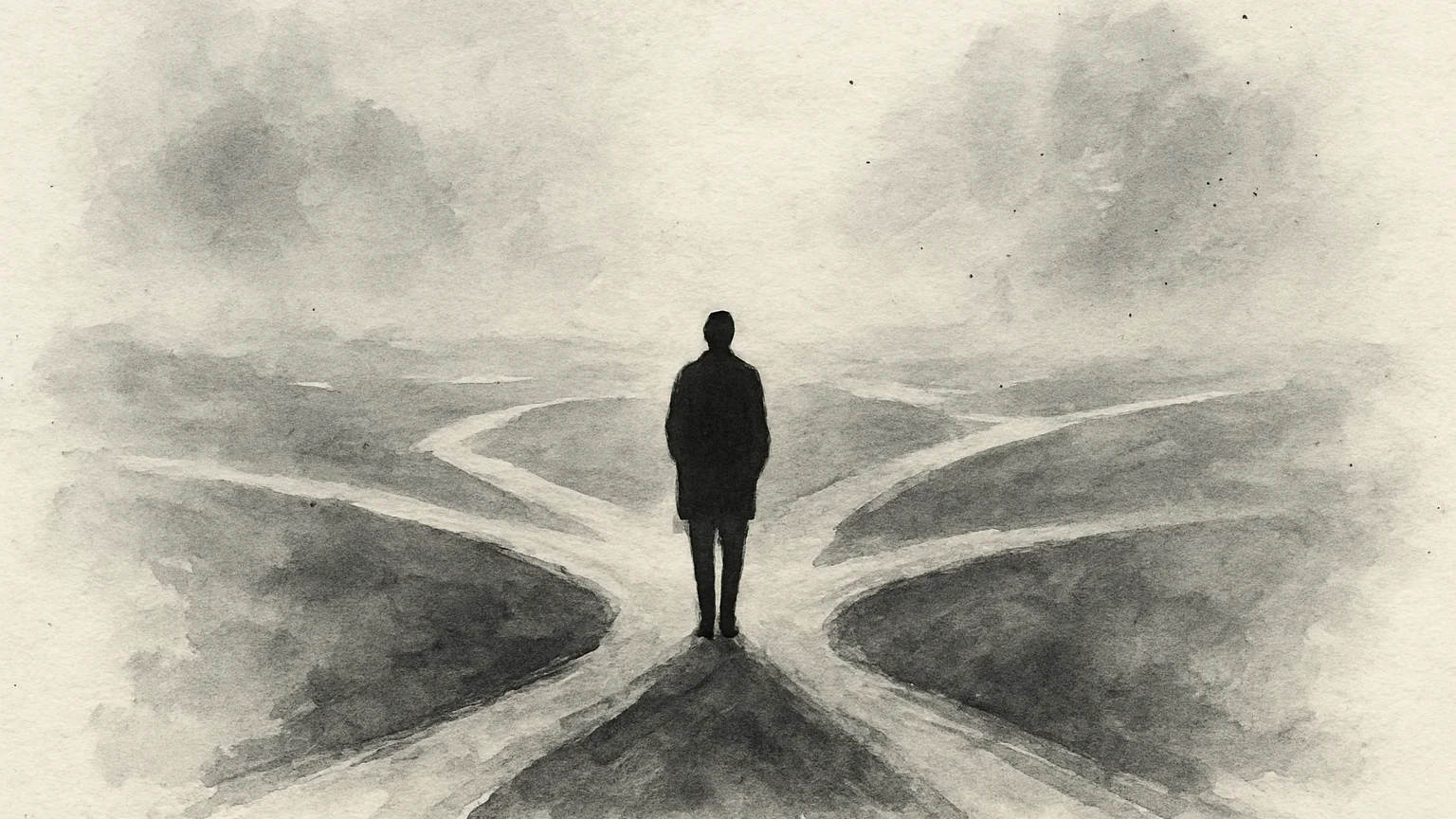
Dreams about being lost are dreams about the missing map. They tend to arrive at life’s crossroads and in the fog just after them — when the next step is genuinely unclear — and unlike the chase or the deadline, this dream has no antagonist at all. That’s precisely what makes it hard to wake from.
What this dream might be about
Put this dream next to its neighbors and its strangeness shows. The chase dream has a pursuer; the lateness dream has a clock; even the falling dream has gravity taking a side. The lost dream has nothing — no enemy, no deadline, often no danger of any kind. Just streets that keep not being the right streets, and the slow, sourceless dread of a person who cannot say which way forward is. It is the only classic dream where the entire problem is the absence of something: a route, a bearing, a map.
Which is exactly what it tends to be carrying. This dream keeps company with the undirected seasons — not crisis, but fog: the crossroads where two futures both look plausible, the months after a structure ends (the degree finished, the job left, the marriage over, the kids launched) when the old route has expired and the new one hasn’t been drawn. People in these seasons often say the same words the dream stages literally: I don’t know where I’m going. The dream isn’t warning of anything. It’s rendering the condition — with weather, streets, and your own two feet.
And notice what you do in it, because the dream watches this closely. Almost nobody stands still in a lost dream. You walk — with terrible purpose, turning down streets as if you knew, retracing, choosing at forks on no information and committing anyway. The dream is full of motion and empty of progress, and that gap may be its sharpest observation: the way a person can be entirely in motion — busy, productive, exhausted — and still, by any honest reckoning, not headed anywhere. If your calendar is full and this dream is frequent, it may be auditing the difference between moving and going.
There’s a tenderer thread underneath, and the dream tips its hand in where it strands you. Lost dreams overwhelmingly involve trying to get back to something — home, the hotel, the car, the group — rarely onward to something new. Beneath the navigation problem there’s usually an attachment question: what currently counts as home base, and whether it still exists to return to. People between belongings get this dream constantly — new cities, new jobs, the year after a family changes shape — because the dream’s real question isn’t where am I? It’s where, now, is the place I’d be trying to reach?
None of these readings is the meaning. They’re the places this dream tends to visit. Which one it visited in you is something only your night, and the life around it, can say.
Lost in a place you know by heart
Your own city, your campus, the streets around your childhood home — and they’ve rearranged. The turn that should open onto your block opens onto somewhere else; the shortcut you could walk blind now bends wrong. The dream isn’t disputing the place; it’s disputing your map of it, and it tends to fire when a system you were fluent in has changed its layout while you weren’t looking — the workplace after the reorganization, the family after the divorce, the friendship that shifted its terms without a meeting. The city is intact. Your fluency is what expired — and the dream is the moment of finding out.
The building that won’t end
Corridors, stairwells, a mall with no exits, a hotel whose room numbers skip yours, a parking garage where the car is on some level that doesn’t exist. Interior lostness is its own dream, and the venue is usually the tell — these are institutional spaces, built by someone else, navigable only on their logic. It tends to visit people lost inside a system rather than a life: the bureaucracy mid-process, the company mid-restructure, the healthcare maze, the application with seventeen steps. You’re not lost in the world in this version. You’re lost in someone’s architecture — and the dream knows the difference even when the waking mind hasn’t named it.
Trying to get home
The purest version: whatever else is happening, the mission is home, and home will not be reached. Sometimes the way is blocked, sometimes the distance keeps growing, sometimes you arrive and it’s the wrong house wearing the right address. This dream tends to come when “home” itself is in flux — after moves, after losses, in the years when the childhood home stops being the family’s center of gravity, in relationships where the place you live has stopped feeling like the place you land. The dream isn’t failing to navigate. It’s asking, with each wrong street, whether the destination still exists in the form you’re searching for.
The phone that won’t help
The modern classic. You reach for the phone and it betrays you in the dream’s favorite ways — the GPS spins, the screen swims, the number misdials itself four times, the call connects to silence. Some of this is pure dream-physics: sleeping minds render text and screens badly, so phones glitch at night across all dreams. But the lost dream recruits the glitch with intent, because the feeling it’s staging requires your lifelines cut — no rescue, no outsourced bearing, nobody coming with directions. If this detail stood out in your version, it may be worth asking where in waking life you’ve quietly concluded that help won’t connect — and whether that conclusion is current, or just old.
Lost with someone in your care
The version that stays with parents for days: lost, and a child’s hand in yours — or worse, a child who was just here. The stakes transform. Your own lostness becomes secondary to the fierce arithmetic of theirs, and the dream tends to visit people carrying exactly that double weight awake: navigating a hard season while someone depends on the navigation — children, aging parents, a team, a partner in a fragile stretch. The dream isn’t accusing you of losing them. It’s rendering the specific loneliness of being unsure of the way while being, for someone else, the way.
Lost and not minding
The rarest version, and it changes the whole map: somewhere in the wrong streets, the dread drains out, and what’s left is close to wandering — unfamiliar city, no route, and a curiosity you didn’t authorize. Where the other versions mourn the missing map, this one has stopped needing it, and it tends to arrive when a waking search has genuinely relaxed — the pressure to have a plan easing, a season of drift accepted on purpose — or just before that acceptance, as a preview. Being lost is this dream’s whole engine. Discovering you can be lost and all right — that’s the engine turning into something else, and it’s usually worth trusting.
What matters more than the symbol
Here is the honest limit of a page like this one: the same lostness weighs differently in different lives. Wrong streets the month you’re choosing between two careers is not wrong streets the year after a divorce, and neither is the endless corridor dreamed by someone three forms deep in an immigration process. A dictionary can tell you what a word tends to mean. It cannot tell you what the sentence meant — and the dream you had was a sentence, spoken once, in your voice, in the middle of your particular life.
No one can tell you what your dream means — including us. What the lostness was doing in your night depends on what surrounded it: which crossroads your waking life is actually at, what you were trying to get back to, who was with you or wasn’t, and what you felt in the wrong streets — dread, or the first unauthorized flicker of curiosity. Those details are where the meaning lives, and they belong to you.
Before you go looking for meaning
One practical note. The sleeping brain spends part of every night filing maps — consolidating the day’s routes and places into memory — and it files hardest when the maps are new. So lost dreams reliably spike in the weeks after a move, a new job with a new commute, travel, or any stretch of learning unfamiliar ground: the mind is literally rehearsing navigation, and its rough drafts play as dreams of wrong turns. If your lost dreams began around the time your actual geography changed, run the boring reading first — you may simply be watching your internal atlas update. That doesn’t empty the dream of meaning; the mind chooses its stories even when the body supplies the material. But sometimes lost is just moving day, still filing.
Frequently asked questions
What does dreaming about being lost usually mean?
The pattern most often reported ties this dream to direction in waking life — it clusters at crossroads and in the fog after them: career forks, endings, moves, any season where the next step is genuinely unclear. Where the chase dream is about a threat and the lateness dream is about a clock, the lost dream is about a map — specifically, not having one.
Why do familiar places become unfamiliar in my dreams?
Because the dream isn't testing the place — it's testing your map of it. Streets you know by heart rearranging themselves tends to track waking situations where a system you were fluent in has quietly changed its layout: a workplace after a reorganization, a friendship after a shift, a role whose rules moved. The city is the same. Your fluency is what the dream says has expired.
Why does my phone never work when I'm lost in a dream?
Partly craft, partly wiring. Dreams are famously bad at rendering screens and text — the mind struggles to hold stable digits and letters in sleep, so phones glitch in dreams of every kind. But the lost dream also needs your lifelines cut for the feeling to hold, so it recruits the glitch: no GPS, no call that connects, no rescue you didn't navigate yourself.
Why do I keep having dreams about being lost?
Recurring dreams tend to circle something ongoing rather than something sudden. If the lost dream keeps returning, the question is what in your waking life still lacks a route — a decision unmade, a direction unchosen, a version of home that hasn't been redefined since the last big change. These dreams usually quiet down once a bearing is picked, even a provisional one.