Dreams About Fire — What They Might Mean
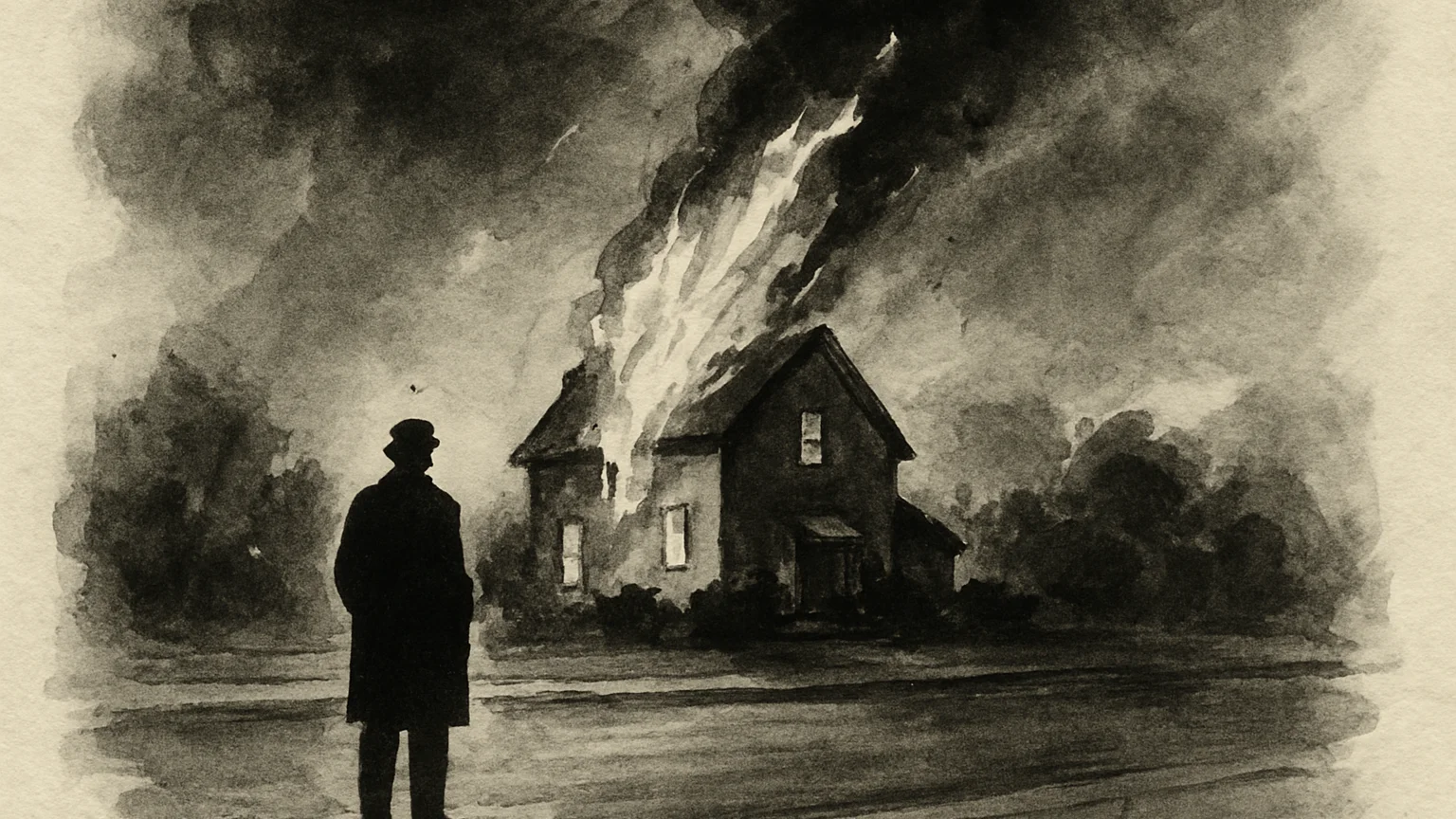
Dreams about fire are dreams about the one disaster we invite indoors. Every other force on these pages arrives from outside; fire is the force we cook with, warm ourselves by, and keep alive on purpose — until it slips its container. That’s the reading at the heart of most fire dreams: something useful, escaping.
What this dream might be about
Notice what separates fire from every neighbor in the disaster block. Water, wave, and wind arrive from elsewhere — visitors, however catastrophic. Fire lives here. It’s on the stove right now; it was the hearth the whole idea of home was built around; it is, uniquely, a disaster that is also a tool — and the dream trades on that dual citizenship constantly. When a dream burns something, the first question isn’t “what threatens me?” but “what of mine got loose?” — because fire in a dream is so often a domestic force past its container: the drive that built the career now eating the life around it; the anger that was legitimate, and banked, and banked, until it found the curtains; the passion that warmed a room and then wanted the room. The dream’s fires almost always start at an appliance of yours. That’s not set dressing. That’s the thesis.
Anger is the classic occupant, and the language got there first: we burn with it, flare up, hold slow burns, call old grievances smoldering — the idiom system files rage under combustion so thoroughly that dreams barely need to translate. Fire dreams cluster in seasons of contained anger especially: the resentment kept professional, the fury kept polite, the thing not said for the third year running — because contained is exactly what fire refuses to stay. And the dream tends to be honest about combustion’s actual physics: fire needs fuel, and it burns what’s nearest first. Dreamers watching a dream-blaze spread through their own rooms are often being shown anger’s real cost structure — that it consumes the holder’s own house before it ever reaches the person it was for. If a fire dream came during a clenched season, the question isn’t whether the anger is justified. It’s usually amply justified. The question is what it’s currently using as fuel.
Burnout is the other resident, and here the dream can be almost clinical — because burnout is not a metaphor about fire, it’s a metaphor about fire ending: the flame that consumed its fuel. Depleted seasons produce a specific fire-dream register that dreamers describe with eerie consistency — not blazes but dying fires: the flame guttering, the fire that won’t catch, embers being blown on desperately, warmth failing in a cold room. If the classic fire dream is force escaping containment, this is its inverse and its sequel — the force spent, the fuel gone — and it visits precisely the people who were the fuel: the ones who burned themselves as the resource, brightly, for years. A guttering-fire dream in an exhausted season isn’t a puzzle. It’s a gauge, reading close to empty — and the only real response to a gauge is refueling, which for people used to being the fuel is the one move that never occurs to them.
And underneath both runs fire’s oldest meaning, the one every tradition agrees on: transformation — the element that doesn’t destroy things so much as convert them, matter into heat and light and ash, nothing passing through unchanged. Some fire dreams are about exactly this and carry surprisingly little fear: things burning that needed to burn, the field cleared, the letters finally lit, the dreamer watching a structure go with something that is not grief. Wildfire ecology has quietly entered the culture’s understanding — some landscapes require burning; some seeds open only in heat — and the dream knows it too. If something in your life is ending in flames at night and part of you is warm rather than frightened watching it, attend to that part. Fire takes. But fire also clears, and the dream may be less about the losing than about the ground it’s making.
None of these readings is the meaning. They’re the places this dream tends to visit. Which one it visited in you is something only your night, and the life around it, can say.
Your house on fire
The heaviest version, because a dream-house is so often the life itself wearing walls — so a house fire tends to be a structure of living under consumption: the marriage, the career, the whole constructed arrangement, being eaten from inside by something that used to be one of its appliances. Two details carry nearly all the meaning. First, the grab: what you ran back in for — dreamers remember it for years, and it’s the dream’s inventory of what, when the structure itself is forfeit, you actually consider essential (people, animals, one object that surprises you; the list is usually short and usually right). Second, the watching: grief at the curb is one honest report. But a striking number of dreamers, standing before the burning life-structure, report relief — and wake ashamed of it. Don’t be. That relief is data of the first importance: some part of you has wanted out of that building longer than you’ve admitted, and the dream, unable to say it, showed you your own face in the firelight instead.
You started it
Two versions, opposite readings. The accidental one — the stove left on, the candle forgotten, the small negligence blooming into catastrophe while you watch with that specific dream-guilt — tends to visit responsibility’s anxious keepers, and its subject is the fear of your lapse costing everything: the detail unmissed for years except once, the vigilance that can’t be sustained forever. It runs, like the forgotten-baby dream, hardest in the most careful people, and carries the same reassurance: the dream drills the failure because failing is unthinkable to you, not because it’s likely. The deliberate version is another animal entirely — the match struck on purpose, the structure lit with intent — and it dreams the language of burning it down: rage at a system finally given its expression, or the fantasy of liberation by destruction — the job, the obligation, the whole arrangement, torched rather than untangled. The dream isn’t a plan and shouldn’t be read as one. But the wish is real and worth hearing soberly: something has you feeling that only fire gets you out. Untangling exists. The dream is telling you how far past patience the feeling has gotten.
The small flame that spreads
It starts as almost nothing — a curl of flame in a wastebasket, a spark in dry grass, something you noticed and deemed manageable — and the dream’s whole engine is the spread: doubling, catching, outpacing every response, until the manageable thing owns the horizon. This is the ignored ember, and its waking counterpart is usually easy to name because you’ve already half-named it: the small debt, the small symptom, the small silence in a marriage — the thing that was genuinely small when you first decided not to deal with it, and has been quietly converting fuel ever since. The giant spider makes the same point by inflation; the fire makes it by arithmetic, and fire’s arithmetic is exponential, which is the dream’s real message: the cost of waiting isn’t linear. Whatever the ember is, the dream has watched it double twice. It’s suggesting now — while it’s still a wastebasket, not yet a wall.
Putting out fires everywhere
The idiom, lived: a blaze in the kitchen, contained; smoke from the bedroom; the yard catching as you fill the bucket — a whole dream spent in triage, each fire small, the sum unbeatable. This is the firefighting life rendered at scale, and it belongs to everyone whose days are actually structured this way — the manager, the parent of several, the one member of the family who handles things — for whom “putting out fires” stopped being a metaphor and became the job description. The dream’s honest observation is in its exhaustion arithmetic: no single fire ever wins, and the firefighter still loses — to the rate. Dreamers wake from this one tired in the body, and the tiredness is the message: a life spent entirely in response has no line item for the person responding. The dream can’t reduce your fires. But it’s worth noticing that in the dream, as perhaps in the day, nobody else is holding a bucket — and asking why the roster is one name long.
Trapped, or burned
Contact — the versions where fire stops being watched and starts being felt: the exit walled in flame, the room shrinking, or the touch itself, the burn on skin. Trapped-by-fire tends to visit consuming situations with no visible exit — the obligation that’s eating you and can’t be left, the conflict burning in a space you’re locked into — and it shares DNA with the sealed car in rising water: the structure that carries you, become the thing you can’t get out of. Being burned is more pointed, because the idiom got there first: getting burned is what we call trust that cost us — the deal, the friend, the love that reached back scorched — and dream-burns often follow waking ones with bookkeeping accuracy. One old kindness applies to both versions: burns teach flinches, and flinches outlive their fires. If you’re dreaming the burn long after the event, the dream may be less about the old fire than about the hand you’ve kept withdrawn ever since — and whether everything warm is really still a threat.
The ashes
The dream opens after: the fire out, the structure gone, gray light, and you moving through the ash — and like the tornado’s debris walk, this is inventory, but fire’s version has its own strange grace, because fire is selective in what it can’t take. Dreamers sifting dream-ashes reliably find things intact — the metal box, the ring, the photograph impossibly unburned, the foundation itself, still square and solid under all that loss — and the finds are the meaning: what survives a total burning is the dream’s statement about what, in you or your life, is actually fireproof. These dreams tend to come on the far side of real conflagrations — the divorce finalized, the business closed, the anger finally spent — and they are quietly among the most hopeful dreams in this library: the mind, done grieving the structure, gone looking through the ashes for what to build with. It always finds something. Note carefully what yours found. That’s the material the next thing gets made from.
What matters more than the symbol
Here is the honest limit of a page like this one: the same fire burns differently in different lives. A guttering flame in your fourth year of caregiving is not a house fire the month a marriage is ending, and neither is the match struck deliberately by someone five years into a job that’s eating them. A dictionary can tell you what a word tends to mean. It cannot tell you what the sentence meant — and the dream you had was a sentence, spoken once, in your voice, in the middle of your particular life.
No one can tell you what your dream means — including us. What the fire was doing in your night depends on what surrounded it: which of your own forces has slipped its container, what fed the flames and what you ran back in for, whether you fought it, fled it, lit it — or stood at the curb feeling something you didn’t expect. Those details are where the meaning lives, and they belong to you.
Before you go looking for meaning
One practical note. Fire dreams have the simplest body-source in the library: heat. An overheated sleeper dreams warm — hot rooms, heavy duvets, fevers (whose famous dreams run to flame for exactly this reason), and night sweats, including the hormonal kind, all reliably write fire, smoke, and burning buildings into the night. Heartburn does it too, with the language’s usual honesty. Beyond the body: wildfire regions and wildfire seasons seed these dreams the way coastlines seed waves, and the news does the rest. So before the symbol, the thermostat: was the room hot, the blanket heavy, the forecast smoky, the reflux acting up? Sometimes the burning house is just a warm bed, narrated. Rule out the duvet before the metaphor — the metaphor will keep.
Frequently asked questions
What does dreaming about fire usually mean?
Fire is the only disaster we keep in our homes on purpose — stove, hearth, candle — which is the key to its dreams: it's the useful force that slips containment. The pattern most often reported ties fire dreams to exactly that structure in waking life: energy that was serving you — anger, passion, drive, work — grown past its container and starting to consume what it was meant to warm. The idioms carry the map: flare up, burn out, playing with fire.
What does it mean to dream about my house burning down?
Houses in dreams often stand in for the dreamer's own life, so a burning house tends to be a structure of living under consumption — a role, a marriage, a way of life being eaten by something from inside it. Two details usually hold the meaning: what you ran back in for, and how you felt watching it burn. Grief is one report. A surprising number of dreamers report relief — and that's a finding, not a malfunction.
Does dreaming about fire mean I'm angry?
Often enough that it's worth checking — the language itself files anger under fire (burning with it, flaring up, inflamed, incendiary), and dreams stage the idiom, especially anger that's been contained a long time. But fire holds more than rage: it's also passion, depletion, and transformation. The behavior decides — anger tends to dream as spreading and consuming; burnout as a fire running out of fuel; desire as warmth that turned.
Is a fire dream a warning — should I be checking my smoke detectors?
The dream isn't a warning; dreams don't forecast fires or anything else. But since you're here and the thought occurred: smoke rarely wakes sleepers — smell mostly switches off during sleep, which is exactly why detectors exist. So no, the dream carries no message about your wiring. Test the detectors anyway, this week, because that part of the thought was simply good — it just came from you, not the dream.