Dreams About Weddings — What They Might Mean
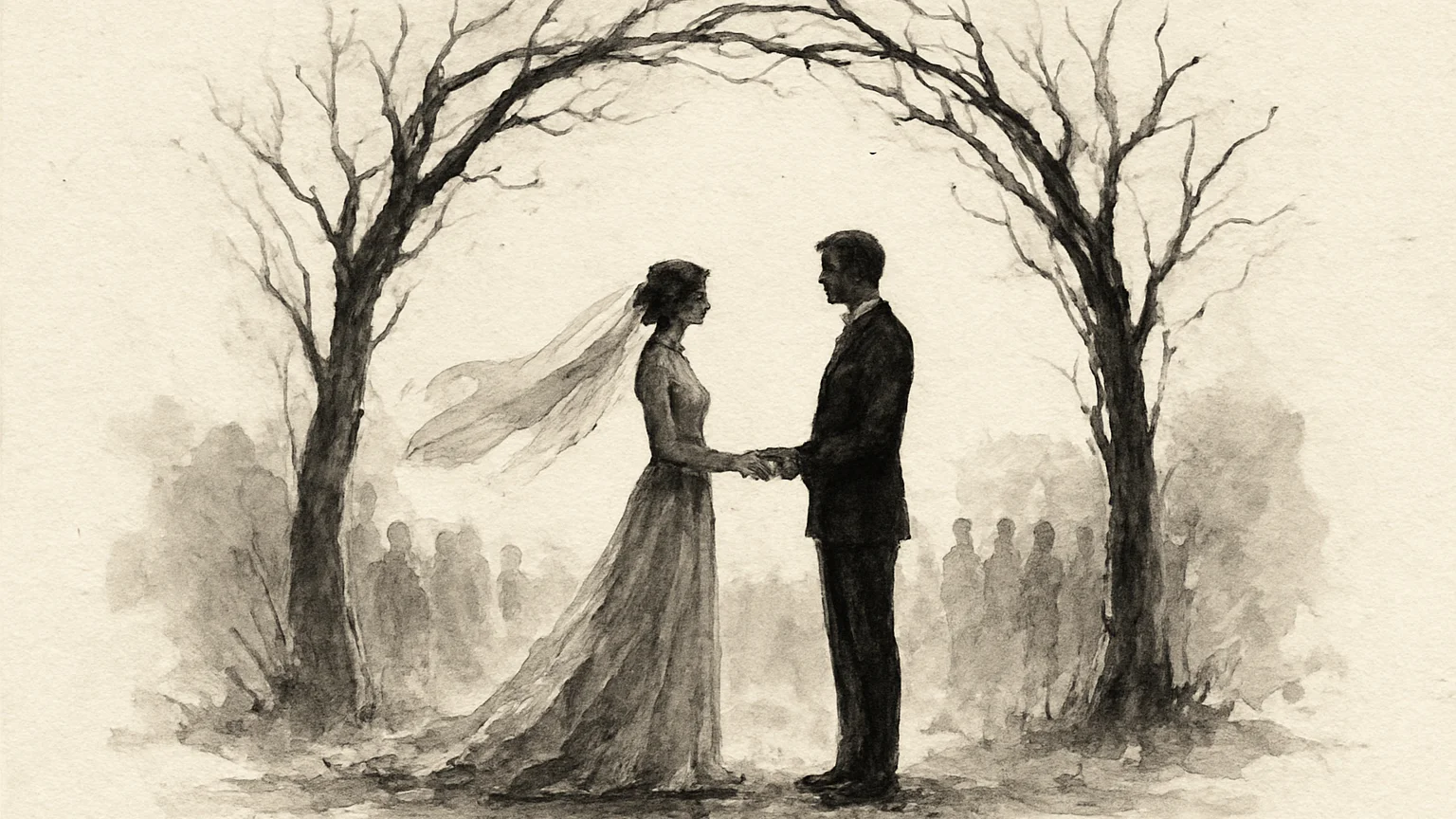
Dreams about weddings are dreams about the binding yes — commitment at its most formal, public, and irreversible. They visit the engaged as pure event-rehearsal, and everyone else as a question about whatever in their life is currently asking for vows: a person, a path, a signature, a self.
What this dream might be about
Consider what a wedding actually is, stripped to the mechanism, because the dream uses the mechanism: it is the culture’s technology for making a choice unretractable — one yes, said once, in front of witnesses gathered precisely so it cannot later be unsaid. Nothing else in ordinary life binds like this or is staged like this. So when a dream builds an aisle, it is rarely idle about romance; it’s reaching for its strongest available image of commitment crossing the point of no return, observed. And the dream’s geography does the talking: everything in a wedding dream is about position along that aisle — approaching the binding moment, standing at it, hesitating before it, or watching someone else arrive there ahead of you.
For the engaged, first, the literal reading — because if you have a real date set, your wedding dreams are almost certainly about the wedding, and their famous chaos deserves demystifying. The disaster versions — dress wrong or missing, venue transformed or double-booked, vows evaporating at the microphone, guests seated in a field, you somehow late to your own ceremony — are the standard pre-event rehearsal dream, the same machinery that runs exam dreams before exams, stress-testing the production your mind has been project-managing for months. They intensify as the date nears, they select for the people who most want the day to go beautifully, and they carry no verdict whatsoever on the marriage. The dream is auditing the event, not the choice. (The choice gets audited too, sometimes — but that dream looks different, and it’s below.)
For everyone else, the aisle usually leads somewhere non-romantic, and the reading is worth trying wide: what in your life is currently asking for a binding, witnessed yes? The job offer that would close other doors. The house, the mortgage, the city. The business partnership — literally called a marriage by everyone who’s been in one. The decision to commit to the craft, the faith, the treatment, the version of your life you’d be choosing out loud. Wedding dreams cluster at these thresholds with the same reliability that death dreams cluster at endings, and for the same linguistic reason: the metaphor is load-bearing. We are wedded to plans; we marry into obligations. The dream stages the figure of speech, complete with guests — and the guests matter, because their presence is the dream’s way of saying this yes will be seen. Private resolutions don’t get aisles.
And sometimes the marriage is interior. The dream’s stranger-vows and mismatched altars have an old reading with real legs: the wedding as integration — two parts of a self, long separate, being formally joined. People mid-becoming get wedding dreams that confuse them precisely because no outward commitment is anywhere in sight: the ambitious self marrying the soft one, the person you were before marrying the person you’ve had to become. Treat it as one reading among several, not a skeleton key — but if your wedding dream had no candidate in waking life and the figure at the altar felt oddly familiar, it’s the reading worth sitting with. Some vows are between you and you. The dream just likes a ceremony.
None of these readings is the meaning. They’re the places this dream tends to visit. Which one it visited in you is something only your night, and the life around it, can say.
Your own wedding — again
For the already-married, dreaming the wedding you actually had — or a new one, to the same person — has its own quiet register. Sometimes it’s simple renewal: anniversaries, hard seasons survived, the mind returning to the founding document. Sometimes the dream revises — different venue, different weather, vows you don’t remember agreeing to — and the revisions are the content: what the commitment has become, rendered as what the ceremony would look like if it were held today. Dreamers report versions ranging from luminous to unsettling, and both are honest inventory. Marrying the same person again in a dream is rarely a question. Noticing what the dream changed about the day — that’s the question.
Marrying a stranger
The aisle is real, the dress is real, the yes is forming — and the face at the altar won’t resolve. This version tends to visit when a binding commitment is taking shape toward something not yet fully known: the career leap whose destination is genuinely uncertain, the move to the city you’ve never lived in, the future being chosen on faith rather than acquaintance. The dream renders the exact structure of that position — maximum yes, minimum information — and how you felt about the stranger is the reading: calm at the altar suggests the trust is real; panic rising as the vows approach suggests the yes is outpacing the knowing. And per the reading above, sometimes the stranger is a resident: a part of you, unrecognized, that some deeper process has decided it’s time to be joined to. Strangers at altars are rarely strangers all the way down.
The wrong person at the altar
You turn, and it isn’t who it should be — an ex, a near-stranger, someone impossible — and the ceremony proceeds anyway, with that specific dream-logic dread of a mistake everyone else seems fine with. Handle this one with the care the casting deserves: for partnered dreamers it does not mean the relationship is wrong — the dream trades in the feeling of misfit commitment, and it borrows faces freely. Its more reliable reading runs to any binding that doesn’t sit right: the role accepted that fits like someone else’s suit, the path locked in during a different chapter of life, the obligation you keep re-signing out of momentum. The dream’s true horror isn’t the wrong person. It’s that the ceremony continues — the yes proceeding on schedule while something in you objects and no one hears it. If any commitment in your life currently feels like that, the dream has named it. Speak-now moments exist outside churches too.
Everything going wrong
The full catastrophe reel — covered above for the engaged, for whom it’s rehearsal, but it visits the unengaged too, and there it shifts meaning: a public commitment whose staging is escaping you. The launch with the date announced and the product unfinished; the move declared to everyone and unraveling in private; any yes said out loud whose logistics are now performing their own opinion. The dream separates the choice from the production and locates the panic precisely in the production — which is often the accurate diagnosis, and a genuinely useful one. Dreamers wake from this version thinking the dream doubted their decision. Read closer: the decision stood through the whole dream. It was the flowers that revolted. What in your life is a good yes, badly staged?
An ex’s wedding — or marrying yours
The invitation dream: watching an ex marry, or standing at an altar with one, and waking with the whole unresolved file open on your chest. Both belong half to another page and it holds the deeper story — but the wedding setting adds its specific charge: finality. Watching an ex marry is the mind staging the door closing all the way, and it visits people at every stage of done-ness, including thoroughly; often it’s less about wanting them back than about witnessing, formally, that a possible life is now closed — which is a real thing to grieve even when the closing is welcome. Marrying an ex in a dream, meanwhile, is usually the past asking whether some old yes ever got fully unsaid. Neither predicts anything, least of all reconciliation. Both are the archive, holding a ceremony.
Watching someone else marry
A friend’s wedding, a sibling’s, a stranger’s you’ve somehow been seated at — and you in the pews, watching someone else arrive at the binding moment. The reading usually runs through the watching: sometimes it’s simple — wedding season is real, the invitations are on your shelf, and the dream is attending in advance. But when the dream lingers on your seat, on the distance between the pews and the altar, it tends to be working the milestone register: someone’s life formally advancing while yours holds position, the years when the ceremonies cluster and each one quietly asks where you are. The ache in that version isn’t envy, mostly. It’s the pew’s-eye view of the aisle — and the dream’s honest question about whether you’re waiting for your own binding moment, avoiding it, or simply between them, which is also a place to be.
What matters more than the symbol
Here is the honest limit of a page like this one: the same aisle leads somewhere different in every life. A dream wedding three weeks before your real one is not a dream wedding the month you’re weighing a one-way job offer, and neither is the stranger at the altar dreamed by someone slowly becoming somebody new. A dictionary can tell you what a word tends to mean. It cannot tell you what the sentence meant — and the dream you had was a sentence, spoken once, in your voice, in the middle of your particular life.
No one can tell you what your dream means — including us. What the ceremony was doing in your night depends on what surrounded it: which yes in your life is currently approaching its witnesses, who stood at the altar and how their face sat with you, whether the vows felt like arrival or like a mistake proceeding on schedule, and what you felt when the ring — or whatever the dream used for one — went on. Those details are where the meaning lives, and they belong to you.
Before you go looking for meaning
One practical note. Wedding dreams have two of the most literal triggers in all of dreaming. The first is having one: if a real date is set, the dreams are your event-brain working nights, and they will intensify toward the date, peak in the final weeks, and vanish almost comically fast once the day is done — couples routinely report the disaster dreams ending the night of the wedding itself. The second is attending them: wedding season fills nights the way it fills weekends, and an invitation on the shelf is a reliable seed — the mind rehearses outfits, speeches, and seating charts it hasn’t consciously started on. So before the symbol, check the calendar and the mantelpiece: if there’s a ceremony ahead in your actual life, yours or anyone’s, the dream is probably just early to it. Some weddings in dreams are only weddings — arriving, as the real ones do, months before the day.
Frequently asked questions
What does dreaming about a wedding usually mean?
A wedding is the dream's image for the binding yes made in public — commitment at its most formal and least reversible — and the pattern most often reported ties these dreams to exactly that territory, romantic or not: the contract signed, the house bought, the path chosen with witnesses. For the engaged, the reading is usually simpler: the wedding dream is about the wedding, in all its looming logistics.
What does it mean to dream about marrying a stranger?
It's one of the most searched wedding dreams, and the stranger is the point: you're saying the biggest yes there is to something whose face you can't make out. It tends to visit when a major commitment is forming toward something not yet fully known — a path, a change, a future taking shape before it has features. One older reading calls it a marriage within: committing to an unrecognized part of yourself. Either way, the dream isn't predicting a person. It's measuring a yes.
I'm engaged and keep having nightmares about my wedding — is that normal?
Near-universal. In the months before a real wedding, dreams of everything failing — the dress wrong, the venue gone, the vows forgotten, arriving late to your own ceremony — are the standard pre-event rehearsal, identical machinery to exam dreams before exams. They cluster as the date approaches, run hardest in the people most invested in the day going well, and say nothing about the marriage. They're about producing an event, not choosing a person.
Does dreaming of a wedding predict a marriage — or a death?
Neither. The marriage-prediction is ordinary wishful folklore; the death version comes from an old tradition of dream-inversion, where weddings foretold funerals and funerals weddings — memorable, and baseless. Dreams don't forecast ceremonies of any kind. If a wedding is somewhere on your horizon or your invitation shelf, that's why it's in your nights.